Installing Garden Decking – Some useful guidelines

 Installing Garden Decking

Download our installation guide

View our installation video

The over site should be:

  • Free Draining
  • Designed to minimise the future growth of vegetation
  • Solid for Ground Level patio style Decks

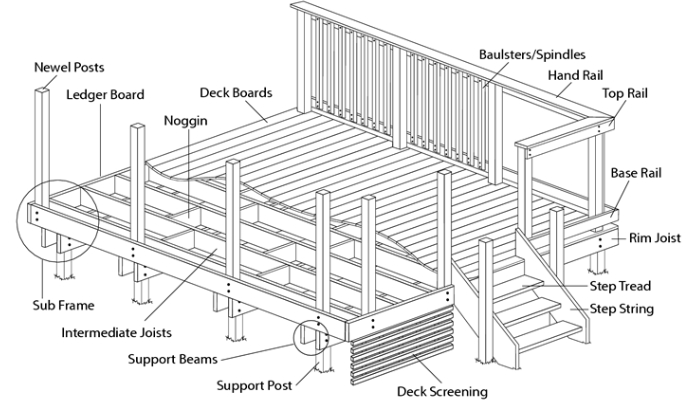
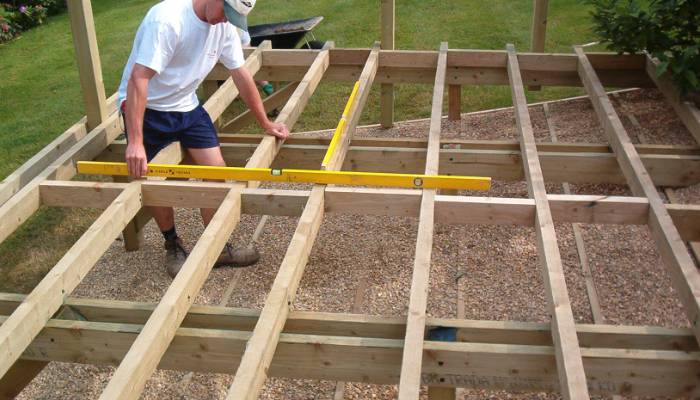
The sub frame supports the decking and balustrading and bears onto the over site. It is very important that it is well designed and constructed. Get this right and you'll have a firm and easy maintainable deck structure, get it wrong and problems can arise in the future.

Patio Style Deck

Here are four typical sub frame designs used in the U.K.


Patio Style Deck
Raft type construction on an area of your garden area that drains sufficiently well.
Low Level Deck
Low Level Deck
Post and beam type construction, where you may have a limited final deck height.
Elevated Deck
Elevated Deck
Post and beam type construction, where you may have a sloping site, the need for a multi-tier decks or simply where the final deck height is not an issue.
 Deck Over Existing Patio
Deck Over Existing Patio
Battens, joists or beams bear on the existing structurally sound concrete slab (ie. 100mm slab on top of 100mm compact hardcore as a minimum) via either durable packing material or sufficiently strong galvanized angle brackets to ensure the timbers are out of ground contact.

Fitting Newles for Decking

Fitting Newels

If balustrading is planned, fit your newel posts before laying decking. Double beam construction using Q-Deck® PLUS multi-purpose posts provides the ideal newel post housing.

Newel posts should be fixed in at least two directions ideally three. The best method is to bolt them to a joist or a beam however for speed you can use suitable structural landscaping screws but these do not provide as secure a construction as through bolting.


Fitting Deckboards

Fitting deckboards

Deck boards should be surface dry and laid with no less than a 6mm gap between boards (this allows for seasonal shrinkage or swelling). Maintain this gap when fitting boards around newel posts for a neat finish whilst still allowing water 'run off'.

It is advisable to loosely lay components, ie. in particular deck boards, out on the finished sub frame prior to securing them. The longer they are left to become surface dry the less the effects of shrinkage will be apparent after fixing them. The timber can also be cut and sanded more easily when dry.

It is advisable to pre-drill pilot holes near the end of boards to avoid splitting.

Fix boards with corrosion resistant screws, or for the very best results use stainless steel screws (2 screws 15-20% of it's width in from each edge of the board).

Laying in patterns or at a 45° angle efficiently utilises any length purchased.


Fitting handrails and spindles

The height of the spindles and handrail depends on how far the deck surface is off the ground. Building regulations state that for ‘low-level’ decks up to 600mm from ground level, the height should be 900mm. For ‘high level’ decks over 600mm high, the height should be 1100mm. However, you may also choose to incorporate one purely as a design feature. There are so many Q-Deck plus components and thus construction techniques related to balustrading that it is necessary to detail how to construct them fully in the downloadable guide. Here are some finished Q-Deck plus systems:


Flat Handrails for Decking Dekorators for Decking Columns for Decking Traditional Decking
  Flat Handrails Deckorators Columns Traditional

Stair and Steps for Decking

Fitting steps and stairs

Simple steps can be created by extending different levels of sub frame or by simply bearing the step frame on compacted hardcore and weed barrier.

You can create stairs using the Q-Deck® PLUS Multi-purpose range of products. However, it is advisable to seek the skills of an experienced tradesman.

Note: All cut ends and notches made to the timber components must be protected with a suitable brush-on end grain preservative (eg. Ensele®) to maintain the integrity of the preservative treatment.